
Scent memories are very powerful, and can anchor us to our childhood, our roots, our culture. This December, I sat down to look at the scented traditions from my motherland, Czechia, and tried to find the origins and purpose for each of them. I also created essential oil blends inspired by the stories I found.
Wintertime in the Czech republic (November – February) usually lacks scents in nature which lays dormant under ice and snow. Not to mention that with the cold and dark days, we don’t spend a lot of time outside anyway. So perhaps to make up for nature being blanketed, many traditions around this time of year revolve around scents and spices.
I invite you to join me on the journey through the Wintertime smellscape of Czechia, and perhaps it will inspire you to think of similar memories.
Tangerines, oranges and spices
 Orange-colored citrus fruits make their first appearance on St Nicolas day, which is December 5th. In our tradition this day is when people dress in costumes of St Nicolas, along with an angel and a devil, and go from house to house to talk to children to decide whether they had been good or naughty. The angel is there to praise the good deeds, while the devil – dressed in black and fur, rattling chains and carrying a big burlap bag – threatens to grab naughty kids and carry them off to hell!
Usually the kids are expected to have a little song or poem ready to perform for the group, and in return they get a small bag of treats. These would be what most consider stocking fillers – chocolates, little toys, and a potato or a piece of coal as a reminder that hell is always watching. It also included my favorite fruit of the season – Tangerines!
I know this varies by preference and type of fruit, but I like to eat my Tangerines by first peeling them – my fingers covered in what I now know included some freshly squeezed essential oil. I tried to keep the peel in one piece as an extra challenge, and the smell of the Tangerine was always an unmistakable signal that December and its festivities had indeed arrived.
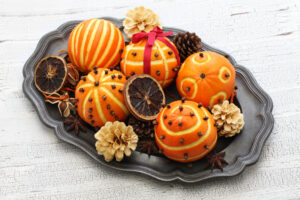
Oranges play a big part, too, especially in the form of clove-studded decorations – pomanders (see image above). Interestingly, other citrus scents like Lemon or Lime tend to be associated with summer, even though the essential oils are so similar. I wonder if this is due to the color perception and preference of orange hues, or if there is a historical reason for this. I may visit that rabbit hole at some future time.

Advent orange hedgehog, courtesy of CeskyKutil.cz
I really went down memory lane this Christmas, all the way back to holiday-themed school projects from first grade – the orange “Hedgehog”. The hedgehog starts with an orange, and the placement of the clove buds makes the nose and face. Then we would use wooden skewers several inches long and put dried fruit on them – like raisins or bits of apricots and apples – and place them as the spikes on our little creature’s back.
Of course you can also make the “adult” version of a pomander, as a way to naturally scent your home with oranges and cloves. Or you can recreate that smellscape with essential oils.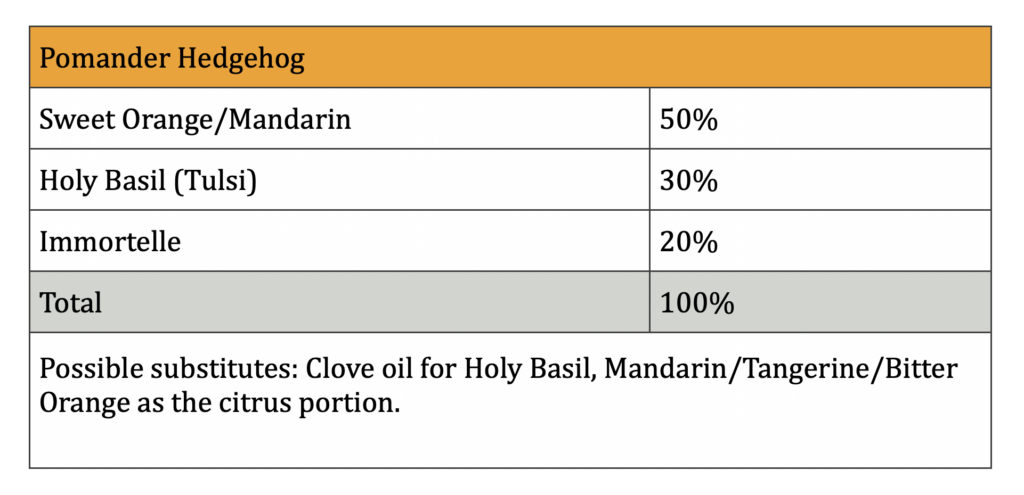
Purpura
This is a very Czech tradition usually focused around Christmas Eve, but can be seen throughout Advent. Purpura as a term comes from the English interpretation of the French phrase “pot pourri” (“putrid pot”). In English this means a bowl with various petals and herbs, used to fragrance a space. The Czech interpretation is somewhat similar in that it is a mixture of dried herbs and spices, but it does not sit idly in a pot on a table. Purpura is supposed to be sprinkled over a hot stove plate to release the volatile compounds of all the wonderful fragrant ingredients. It’s not supposed to burn – we have our St Francis incense cones for that (see below).
The exact mixture varies, and usually includes some Frankincense resin, wood chips from conifer trees, maybe some Rose petals, plus dried herbs and spices such as Oregano, Thyme, Marjoram, Cinnamon, Nutmeg, Star Anise, Spruce needles… really anything fragrant that can be found around the household at the time. The specific scent is not easy to recreate with essential oils, though blending herb and spice oils with conifer oils may be a good way to go.
“Frantisek” or the St Francis of Assisi Incense Cones
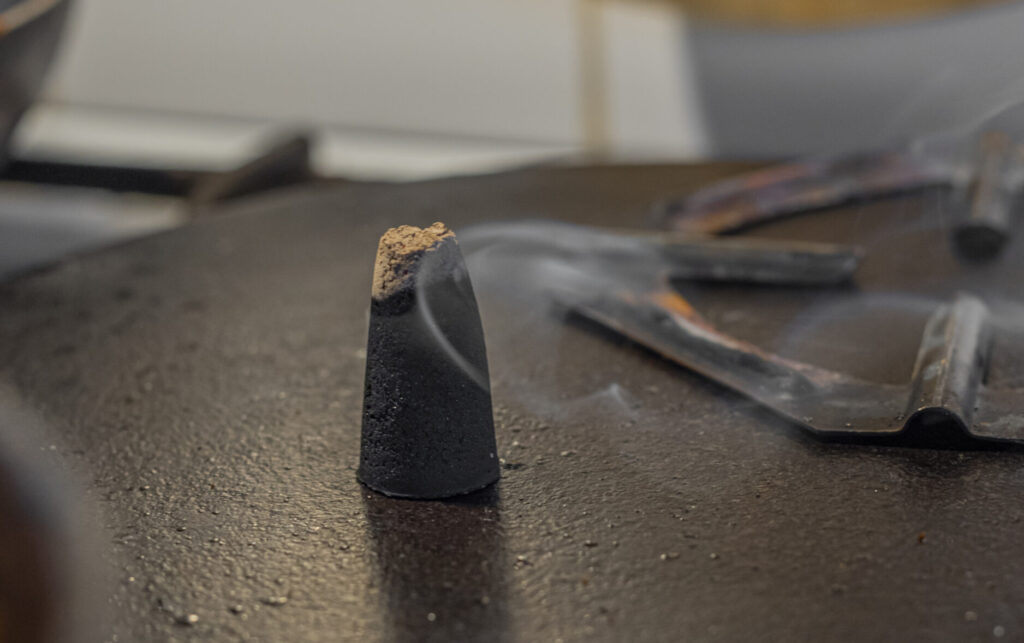 Simple, two-ingredient incense cones are another smell staple in Czech households. They are made from linden wood sawdust (linden trees are prolific in Czechia) and powdered Frankincense, and are used as you would an incense stick – you set the top alight and leave it smoldering while it releases the scent into the air. They have been in use in this form for over 300 years, though the tradition of using incense is, of course, much older.
The St. Francis incense was a great accompaniment in the holiday period – a time traditionally reserved for slowing down, contemplation, and going within. Frankincense essential oil will bring a similar experience, though the burning adds another dimension to the smellscape. An undertone of Vetiver may help with that.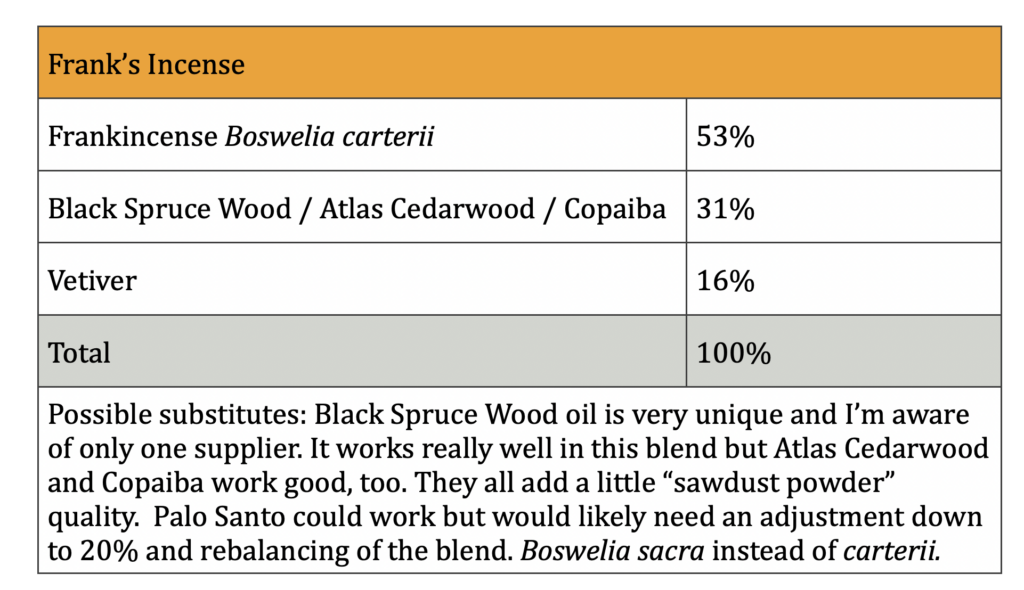
Mulling and gingerbread spices
You have heard of pumpkin spice, but I want to talk to you about these two cousins: mulling spices and gingerbread – or lebkuchen – spices. Both of these spice mixtures, as well as the preparations they are added to, are an ancient tradition, with spice wines dating at least back to Roman times.
Adding spices to subpar or leftover wine was a way to prevent waste – and perhaps add some medicinal properties too. Nowadays, mulling spices are used to make mulled wine or apple cider, and the base mix is Cinnamon, Clove and Star Anise. You can add Cardamon or Ginger, and an orange slice will often make it’s way into the mulling pot as well. If you have ever strolled through a Christmas market with a cup of mulled wine in your gloved fingers, you know that it will warm your body and spirits very quickly. While the Romans may not have always used spiced wine in winter, over time it became a staple of colder months when people spend more time indoors and respiratory infections spread more easily.

Germany, the Czech Republic and surrounding countries have their own category of spiced cookies. Calling them gingerbread is a bit of an approximation as the spice blend rarely contains ginger. The German term is Lebkuchen, Honigkuchen or Pfefferkuchen, and us Czechs call them Pernik or Medovy pernik. They are usually sweetened with honey (hence the “honig”), and flavored with a mix of Cinnamon, Clove, Cardamon, Star Anise, Allspice, Aniseed, Coriander, Fennel and Black Pepper. The base trio of spices is the same as for the mulling mix: Cinnamon, Clove and Star Anise (or Aniseed). While these are very often linked to Christmas time and winter in general, you can also find them year round at various fairs and festivals.

Conifers
We cannot talk about Winter smells without mentioning the evergreens. One last vestige of greenery in an otherwise barren landscape, they bring a welcome reminder of spring inside the household in the form of trees and decorations. Our family used to go for the more evenly grown spruces, and I have a few memories of trying to hang decorations on the very dense branches of a nice silver fir. Then a few years back we decided it would be fun to go in the opposite direction and intentionally go for the most convoluted of available trees – usually a sturdy pine. One year we had one with two trunks, each growing in a very different direction!
Whether you have a full tree or just a conifer branch decorated with festive baubles, the scent of needles brings a promise of spring into the dark and cold days of Winter. This one doesn’t need a blend, just pick a fresh conifer essential oil and you’re good to go. Perhaps blend in a conifer bark oil if you have it, for a full forest impression.
What’s the Winter smellscape like for you?
These scents are not exclusive to the time before and around Christmas – spices and citruses brighten our tables as much as we want them to, and you can adorn your space with a nice scent to brighten the day. We still have two months to go in the Northern hemisphere before flowers start popping out!
I’d love to hear what scents come up for you during the season, or if you’ve made one of the blends – and what you thought of it.
A note on the blends: The blends have been designed and smell-tested as written down. Any substitutes may alter the scent. These blends are meant for inhalation and space diffusion and have not been evaluated for topical application. Consult safety guidelines if you wist to incorporate them into a cosmetic product.

Dear hana, what a wonderful and evocative post. I saved it to read, along with many other wonderful articles, until time and my eyesight permitted. It is now puiping hot january, here in cape town, and i have 9 months of catch-up reading and viewing to do, now that i can see a bit better – since eye problems that escalated in May 2025 and limited my reading pleasures! your article is a total delight and brings back memories of travels in Northern hemisphere winters [we very, very rarely get snow here in ct], the delicious aromas and tastes of christmas markets, pomanders from my childhood, and our own annual fragrant goodies that are swiss heritage inspired. thank you hana – you have a gift with words and weave a lovely aromatoc tapestry.
OOps – seems like the auto-capital comment default has included several typo – including your name [Hana]. Not sure how to edit this to make corrections Hana – apologies